
Among the world's most celebrated long-distance treks, the Annapurna Circuit holds a place of rare distinction. Looping around the entire Annapurna massif in northwestern Nepal, this legendary trail weaves through subtropical forests, terraced farmland, ancient villages, high alpine deserts, and glacier-carved valleys, all in a single journey. While the trek is rewarding in any season, spring (March through May) is widely considered the finest time to undertake it. Longer days, stable weather, blooming rhododendrons, and crystal-clear mountain views make spring an almost magical window for trekkers. Here is everything you need to know before you lace up your boots.
Spring strikes the ideal balance between accessibility and beauty. After the cold stillness of winter, the trails come alive in March with explosions of pink and red rhododendron forests, Nepal's national flower particularly between 2,000 and 3,500 metres. Temperatures are comfortably warm at lower elevations and cold but manageable at higher altitudes, making daily hiking pleasant rather than punishing.
Visibility is another major advantage. The pre-monsoon atmosphere keeps the skies largely clear, especially in March and early April, offering trekkers unobstructed sightlines to some of the Himalayas' most iconic summits Annapurna I (8,091 m), Annapurna II, Gangapurna, Tilicho Peak, and the unmistakable pyramid of Machhapuchhre. By late April and May, afternoon clouds begin to build more frequently as the monsoon approaches, but mornings remain rewarding.
Spring is also one of the busiest trekking seasons, which means teahouses are well-stocked, trail infrastructure is at its best, and a vibrant community of fellow trekkers from around the world shares the path with you.
The full Annapurna Circuit Trek covers approximately 160 to 230 kilometres depending on the variation taken, traditionally completed in 12 to 21 days. The route is most commonly walked in an anti-clockwise direction starting from Besisahar (or Jagat if you skip the jeep road sections) in the east and finishing at Nayapul or Pokhara in the west after crossing the Thorong La Pass.
The journey can be loosely divided into three major phases:
The Lower Circuit (Besisahar to Chame): This opening stretch follows the Marsyangdi River valley through lush subtropical landscapes, rice paddies, and Gurung villages. The trail climbs gradually through Bhulbhule, Ngadi, Bahundanda, and Chamje before entering the narrow Marsyangdi gorge. In spring, the hillsides here are draped in blooming rhododendrons and wildflowers, a spectacular introduction to the trek.
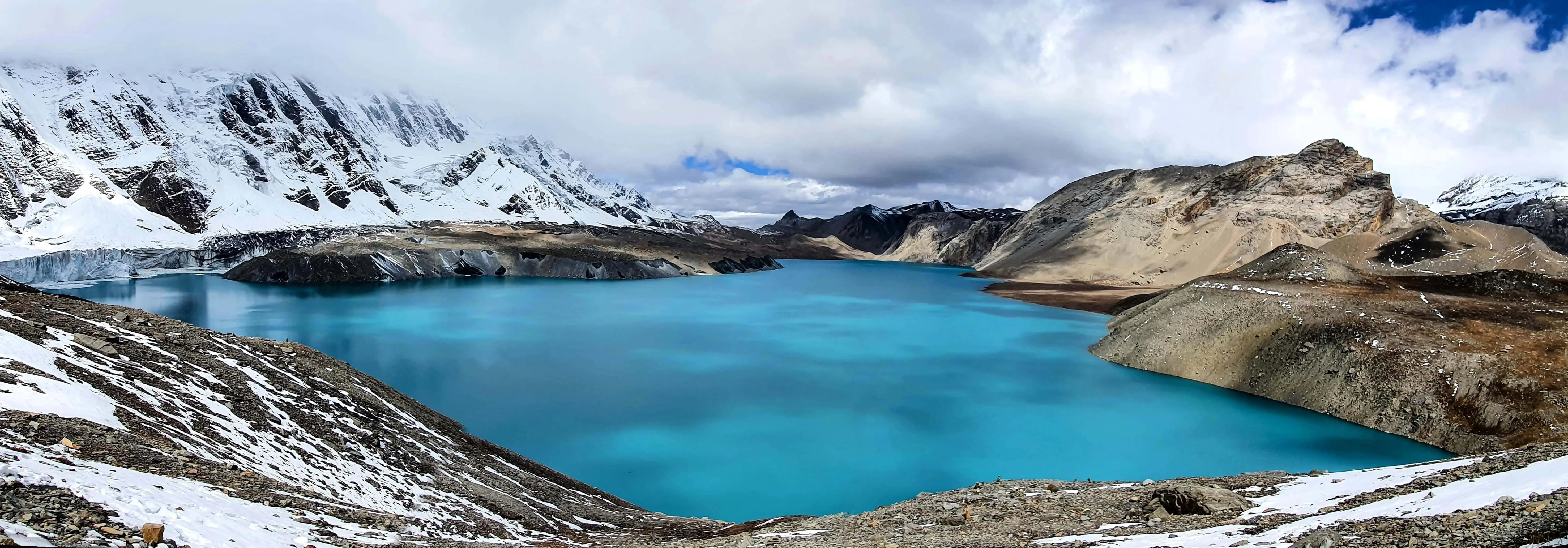
The Upper Circuit (Chame to Thorong Phedi): As the trail climbs above Chame, the scenery transitions dramatically. Pine and oak forests give way to high-altitude scrubland, and the valley widens to reveal the towering walls of the Annapurna and Lamjung ranges. Key stops include Pisang, Manang, and Tilicho Lake, one of the highest lakes in the world at 4,919 metres which makes for a magnificent and popular acclimatisation side trip from Manang.
The High Crossing and Descent (Thorong La to Tatopani): The crossing of Thorong La Pass (5,416 m) is the physical and psychological centrepiece of the entire circuit. Most trekkers depart from Thorong Phedi or High Camp in the early hours typically between 3 and 5 a.m. to summit before afternoon winds and clouds arrive. In spring, the pass is generally snow-free, though a light dusting from late-season snowfall is possible in March. After the crossing, the descent leads into the rain-shadow region of Mustang, culminating at the sacred pilgrimage town of Muktinath. From here, the trail continues through the dramatic Kali Gandaki gorge, passing through Marpha, Tukuche, and Tatopani, before the final stretch to Nayapul.
Understanding the micro-climatic variation along the circuit is essential for preparation.
March is the coolest spring month. At lower elevations, daytime temperatures hover between 15°C and 22°C, while at Manang (3,500 m) expect 5°C to 10°C during the day with freezing nights. Thorong La can still carry residual winter snow in early March, though it is usually passable. Skies are at their clearest this month.
April is widely considered the sweet spot. Temperatures warm pleasantly at all elevations. The rhododendron bloom is at its peak, and the mountains are sharp and vivid against deep blue skies. Crowds increase but remain manageable on most sections.
May brings warmth and longer days, but afternoon cloud build-up becomes more frequent and occasional pre-monsoon rain showers are possible at lower altitudes. High-altitude sections remain dry and clear in the mornings. It is still a very enjoyable month to trek, though finishing your high passes before 11 a.m. becomes increasingly important.
The Annapurna Circuit in spring is not simply a trek, it is a transformative encounter with some of the planet's most dramatic landscapes, deepest cultures, and most welcoming communities. Whether you are a seasoned high-altitude hiker or embarking on your first major mountain adventure, the circuit in its spring glory will leave an indelible mark.
To make your experience seamless, safe, and unforgettable, trust the experts who know these trails inside out. Miracle Treks is a Nepal-based trekking company with deep expertise in Annapurna region expeditions. From customised itineraries and permit arrangements to experienced guides, porters, and teahouse bookings, Miracle Treks handles every detail so you can focus on the journey.
Visit Miracle Treks today to plan your perfect Annapurna Circuit Spring Trek and let the mountains do the rest.
