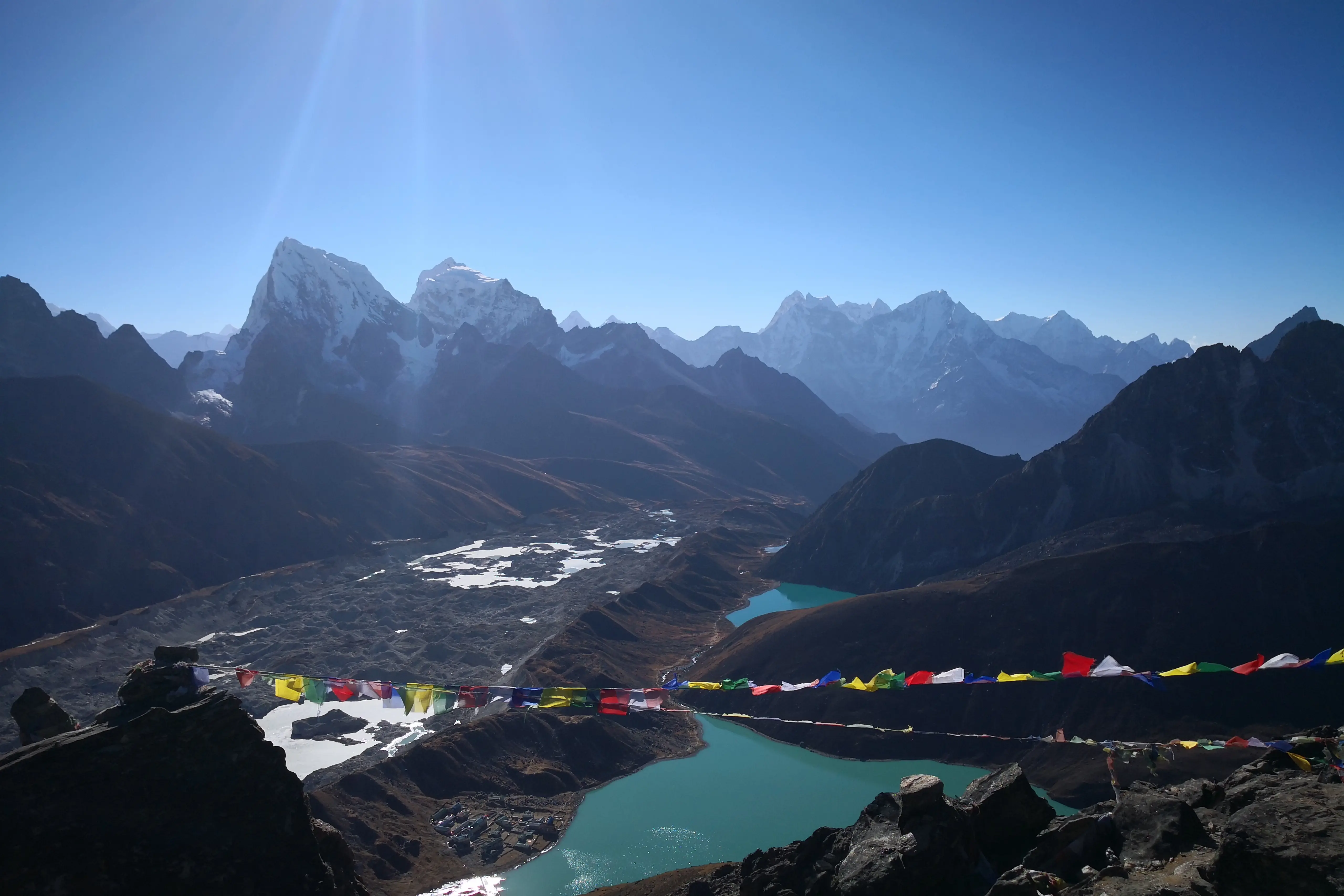
Himalayan Adventure It truly was during my very first minute of admiring the turquoise lakes of Gokyo that I also saw the sunrise behind Mount Everest and was absolutely enthralled and can even now clearly imagine that situation.
At that very instant, I told myself, 'This has to be the reason why people from all over the world keep coming to Nepal for a trek.' It's the serenity, the thin and cold air that the lungs alone can bear, and the huge amphitheatre of Himalayan giants illuminated by the golden light of sunrise. If you wish to take a quieter, less touristy route to Everest Base Camp which at the same time offers stunning mountain views, high passes, glacier crossings, and authentic Sherpa culture – then the Gokyo Valley Trek is probably the most beautiful trek in the Khumbu region.
The Gokyo Valley Trek is a thrilling 15-day exploration of the Everest (Khumbu) region's high-altitude Himalayas in Nepal.
Instead of the usual and often crowded main trail to Everest Base Camp, the plan here is to go off the beaten path to the pristine Gokyo Lakes and ascend Gokyo Ri (5,357 m) – probably the pinnacle of the most incredible views in Nepal.
Along the trail you will encounter: Sherpa settlements Ancient monasteries Forests of pine and rhododendron Glacial moraines High alpine lakes This trek combines a moderately challenging level of physical effort and the stunning natural beauty.
It's an ideal route for those who want to get a glimpse of Everest but at the same time wish to avoid the very crowded EBC path.
Usually, it begins with a short mountain flight from Kathmandu (or Manthali) to Lukla.
Nevertheless, the official trekking route's location of start and finish is: Lukla: After Lukla, you walk to: Namche Bazaar Dole Machhermo Gokyo Within the same valley or via Cho La Pass
The trek ends in Lukla, from where you take the plane to Kathmandu.
Early morning walk to Gokyo Ri (5,357m) Gokyo Lakes (six glacial lake) are emerald green Ngozumpa Glacier (the longest glacier in Nepal) in view Everest, Lhotse, Makalu, and Cho Oyu in a panoramic view of Sherpa culture and monasteries More pixelated than Everest Base Camp (EBC) The sunset from Gokyo Ri is equal to – and many people say that it is even better than – Kala Patthar.
It's primarily the length and altitude that make this trek moderately challenging rather than the technical difficulty aspect. If you are in good shape and ready to walk long distances at high altitudes, it would be a good match for you. Throughout the trek tea houses offer accommodation, and meals are quite simple but filling. The schedule includes a couple of days for acclimatisation, which is very important for a safe and pleasant experience.
Gain: Typically, over a fifteen-day trip, trekkers cover just over one hundred kilometres. The trek starts from Lukla which is at an elevation of less than three thousand metres, and progressively climbs to Gokyo village at just under 4800 metres. The highest part of the trek is when you climb Gokyo Ri, which stands at more than 5300 metres. One of the reasons why the trek is manageable despite the altitude is because the elevation gain is very gradual.
What really differentiates the Gokyo Valley Trek from other routes is the amazing feeling of freedom you get when you are there. The valley appears to be more spacious and less crowded than most of the routes in the Everest region, thus allowing trekkers to experience the Himalayas without the distraction of constant foot traffic. Besides that, the fact that the valley is dotted with a number of glacial lakes makes the scene very unique, as such outdoor elements combined with towering snow-capped peaks are rare in the Himalayas.
Spring and autumn are headline seasons when it comes to trekking in the Gokyo Valley. Spring is associated with milder temperatures and brightly colored vegetation at the lower elevations while autumn is known for fresh air and crystal clear mountain views on a regular basis. During winter one can do trekking, but only if he or she is very experienced and has the ability to tolerate cold weather. Whereas monsoon season most of the time is characterised by persistent cloud cover and flight disruptions.
To prepare oneself for the Gokyo Valley trek, one needs to build up stamina and become accustomed to walking for several hours each day without stopping. Taking walks regularly, climbing stairs and doing some cardio will strengthen the body to handle long hikes. In fact, mental preparation is just as crucial as physical preparation since mountain trekking entails being adaptable and having a lot of patience, especially when there are changes in plans due to weather or altitude.
Trail accommodation along the trail mainly consists of family-run tea houses. The lodges offer basic rooms with shared toilets and a common dining room. As one moves higher up the trek, the amenities get more limited, but the warmth of the hosts is the same. Besides that, living in teahouses also gives you a peek into the everyday life of the locals in the Everest region.
The weather in the Gokyo Valley is very changeable and open and can surprise you. Most of the time you have beautiful mornings but by afternoon, the sky is congested with clouds especially during hot months. Nights are cold, particularly in places that are more than four thousand meters above sea level. Wearing several layers of clothing and being prepared for rapid weather changes will help a trekker remain comfortable throughout the trek.
During the high trekking seasons, the flights to Lukla are often diverted from Kathmandu to Ramechhap. This is done to mitigate the air traffic but it requires the trekkers to rearrange their travel plans. Usually, most of the departures involve a road trip from Kathmandu to the Ramechhap airport early in the morning.
Manthali Airport is situated in the eastern part of Nepal at a distance of a few hours’ drive from Kathmandu. The trip can be a bit tiring but the airport has now become a normal embarkation point for Lukla flights during the peak seasons.
When flying from Manthali, trekkers should expect early morning departures and a longer travel day. Although it is a bit inconvenient, the procedure is quite well-established and once the weather is good, flights generally take place without a hitch.
There are two permits required for the Gokyo Valley Trek - one is for entering Sagarmatha National Park and the other is a local municipality permit. One can either organize these permits in Kathmandu or they can be obtained on the trail before entering the protected area.
There are permit checkpoints at the designated entry points along the route where the authorities check the permits. It is advisable for trekkers to carry their permits close at hand as these checks are quite frequent and they help to control the tourism volume in the region.
Permit costs are set by the local authorities and the money raised goes to conservation and development projects in the Everest region. Compared to the total cost of a trek, the fees for the permits are quite low.
Travel insurance is highly advised and practically necessary if you want to trek in Gokyo Valley. The insurance should cover high-altitude trekking and include emergency evacuation as the medical facilities are very limited in the remote mountain regions.
You cannot say altitude sickness is totally impossible here although it becomes more likely the higher you go, especially after three thousand meters. Altitude sickness can affect anyone regardless of their age and fitness level, thus knowing the symptoms and acting accordingly is very important.
The most effective method of prevention is keeping the pace slow and steady, drinking plenty of fluids, and getting enough rest. Building in acclimatization days gives your body time to adjust and this plus refraining from overexertion lowers the chance of getting altitude sickness tremendously.
At most tea houses there are some basic sanitation facilities and if you pay a little extra, you get a hot shower. As you go higher, the water supply becomes scarce, and the facilities get simpler. Internet and Electricity Access on the Gokyo Valley Trail Electricity is mostly provided through solar panels but you have to pay a tiny fee if you want to charge your devices. The internet is hardly ever available or when it is, it is quite slow, so trekkers are encouraged to disconnect and just enjoy the trek.
The route traces the Dudh Koshi River until it reaches the fork toward the Ngozumpa Glacier and the Gokyo Lakes. It goes up slowly through various villages and alpine terrain thus offering a diversity of views all along the trek. Training and Fitness Preparation for the Gokyo Trek If one trains consistently for a few months, one's body will be ready for long walking sessions at high altitudes. Working on leg strength, doing balancing exercises, and going on practice hikes with a backpack will all make the trekking experience easier.
To ensure both the safety and the enjoyment of the trek, it helps if you walk at a pace that suits you, drink plenty of water, and observe local traditions. Trekkers with flexible attitudes and an open mind about the changing conditions always get the most out of the experience. Guidance for Female Trekkers During Menstruation in the Mountains It is quite possible to have your period while hiking at high altitudes, if only you are well prepared and aware of what that entails. Just make sure that you have enough supplies with you, that you keep clean and that you talk to your guide about any issues if you want to, and there will be nothing to worry about on the trail.
One’s comfort and safety significantly depend on packing the right things. Besides clothes that can be layered effectively, personal stuff should mainly consist of items for keeping warm, for shielding from the elements, and for attending to the basic medical needs.
A good selection of trekking gear like the backpack, poles, and a torch will help you stay comfortable and balanced on the way.
Wearing warm layers that can also wick away moisture helps a lot with regulating body temperature as the conditions change. Torso Layering Essentials You have to keep yourself warm and dry by wearing insulating and weatherproof clothes that will shield you from the wind, snow, and rain.
Quality hiking pants and thermal underlayers will keep you warm and allow you to move freely.
In the mountains it is essential to wear gloves that are good enough for the freezing mornings and for the afternoons that can be a little warmer.
Properly fitted hiking boots and socks of a suitable kind will protect you against discomfort and injuries.
Good-quality and fast-drying inner layers not only promote hygiene but also help in keeping you warm.
Having your personal medical supplies with you at all times even when you are accompanied by a guide is the best idea.
While it is true that guides normally have some emergency equipment, it is important for everyone to take their personal responsibility seriously.
Things like sunblock, water bottles, and other toiletries complete the list of must-haves for packing.
By following the locals' habits and not causing much damage to the environment, you will contribute to the preservation of the region for the future generations and support the mountain communities at the same time.
Charging Plug Types and Electrical Standards in Nepal
Nepal utilizes various types of plugs so a universal adapter would be a handy item to bring with you in your luggage.
Nepal Visa Process on Arrival: Step-by-Step Guide and 2025 Costs
Generally, it's possible to get a visa on arrival at Kathmandu airport by filling in the form and paying the amount based on the duration of the stay.
Depending on your taste, level of experience, and the degree of freedom you want, each way of trekking offers different kinds of advantages.
We plan meticulously, we know the locals, and we pace responsibly so our clients get to stop worrying about the nitty-gritty and instead focus on their experiences or simply relax; hence, the journey becomes smoother and more meaningful.
The best approach to the Gokyo Valley Trek is with patience and a spirit of inquiry. It benefits those who are willing to slow their pace, watch and get in tune with the mountains' rhythms.
This part of the document aims at providing answers for questions that are often asked about permits, accommodation, difficulty level, food, acclimatization, and getting ready generally so that the trekkers may be able to plan their trek with confidence.
