
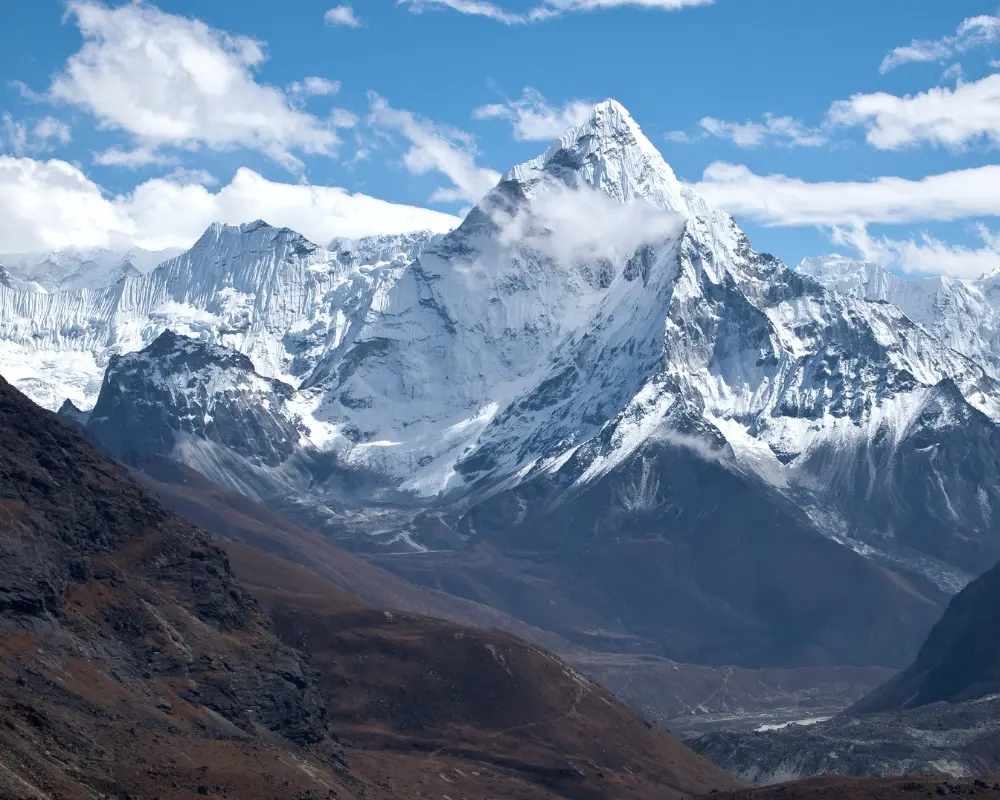
At 17,598 feet (5,364 meters), Everest Base Camp sits higher than every single mountain peak in the United States outside of Alaska. Most of us know that Mount Everest is the tallest point on Earth, but the starting line for climbing it is an extreme environment all its own. For anyone making the trek, reaching the base camp altitude is not merely a geographic milestone, but a harsh introduction to a world where the fundamental rules of human biology begin to change.
Visualizing this massive everest base camp elevation requires looking beyond standard city buildings and looking toward the sky. According to geographic data and architectural records, grasping this sheer vertical scale is easier when compared to familiar landmarks:
Bridging the gap between a high-altitude city like Denver—the "Mile High City" at 5,280 feet—and the roof of the Himalayas highlights a dramatic shift in our atmosphere. Mountaineering science explains that at the base camp height, the air is not actually missing oxygen; instead, the lower air pressure makes the molecules spread out. Breathing here feels less like walking through a densely crowded room and more like wandering across an empty field trying to catch the same amount of air.
Crossing the biological threshold of 17,000 feet serves as the ultimate gateway to what climbers call the "Death Zone." Imagine attempting to climb a steep flight of stairs while breathing entirely through a tiny coffee stirrer. Because of this extreme oxygen deprivation, aviation and medical experts note that you cannot simply fly a helicopter to the camp and safely step out; the human body demands an 8-to-10-day gradual trek to perform acclimatization, a process where your internal systems build more red blood cells just to survive.
Surviving at this monumental elevation transforms ordinary daily tasks into exhausting physical challenges. Even something as simple as boiling water behaves differently, requiring only 185°F (85°C) instead of the standard 212°F (100°C) due to the thin atmosphere. These unique environmental quirks highlight what makes arriving at the foot of Mount Everest such an extraordinary human achievement.
Deciding which side of the mountain to visit means facing two entirely different physical realities. A proper Nepal vs Tibet base camp comparison begins with the numbers. The South Base Camp in Nepal sits at an imposing 5,364 meters (17,598 feet). Across the border, the North Base Camp in Tibet rests slightly lower at 5,150 meters (16,900 feet). While a 700-foot difference sounds minor to someone living at sea level, every single foot alters how your body functions at these heights.
Getting to these iconic locations highlights the true contrast between the regions. Reaching the elevation at Everest Base Camp on the Nepalese side requires a strenuous eight-to-ten-day trek through remote valleys. Meanwhile, Tibet offers a radically different approach. Because a paved road stretches across the high plateau, visitors can literally drive an SUV straight up to the northern camp. Travelers must choose between a demanding physical pilgrimage on foot or a highly accessible, rapid ride.
The ground beneath your boots also changes drastically depending on your route. In Nepal, tents are pitched directly on the Khumbu Glacier, a restless river of ice covered in a chaotic jumble of shifting rocks. It feels rugged and alive. Conversely, the Tibetan side faces the Rongbuk Glacier from a relatively flat, barren stretch of earth. Instead of balancing on moving chunks of ice, northern visitors stand on solid, windswept dirt with an unobstructed, picture-perfect view of the summit.
Ultimately, your preferred journey dictates how you experience the extreme base camp elevation Mt. Everest commands. Whether you slowly hike up the Khumbu Valley or quickly drive across Tibet, both routes eventually deposit you in an environment where human biology struggles. To safely handle either adventure, you first need to understand what happens to the invisible atmosphere around you.
Surviving the base camp environment requires grasping a surprising biological twist. Most people assume that high in the mountains, oxygen simply vanishes, leaving the atmosphere mysteriously empty. In reality, the air you breathe at 17,598 feet contains the exact same 21 percent oxygen as the breeze blowing across a sunny beach at sea level. The crucial difference isn't the recipe of the atmosphere; it is the physical weight of the sky pressing down on you.
To visualize why this matters, imagine gravity as a giant, invisible compressor squeezing the air against the earth. Down at sea level, this intense pressure forces gas molecules tightly together, much like a dense crowd of fans packed shoulder-to-shoulder at a sold-out concert. However, when you climb into the extreme altitude everest environments demand, that invisible weight lifts. Without heavy air pressure pushing them together, those gas molecules drift apart and scatter across a much wider space.
This spreading effect means that every time your lungs expand, they capture significantly fewer life-sustaining molecules. By the time you adapt to the oxygen levels at seventeen thousand feet, you are effectively pulling in 50 percent less oxygen per breath compared to standing in a city like New York. You are still breathing the same type of air, but your body must work twice as hard just to extract the baseline amount of fuel it needs to function.
Because of this deficit, mundane daily tasks suddenly transform into exhausting athletic feats. Simply tying your shoelaces or walking up a slight incline can leave you gasping, creating a sensation similar to trying to run a marathon while breathing through a narrow coffee stirrer. Fortunately, human biology is remarkably adaptable. To survive this harsh deprivation, your system must quickly learn to manufacture its own microscopic delivery trucks.
When your brain detects the thinning air, it immediately triggers an emergency biological response known as acclimatization. Think of this process as your body opening a microscopic factory to build more "delivery trucks"—specifically, red blood cells. Because each breath you take holds fewer oxygen molecules at altitude, your system compensates by flooding your bloodstream with millions of these new cells. This physiological adaptation ensures that every available drop of oxygen gets successfully transported to your struggling muscles and vital organs.
This remarkable internal shift doesn't happen instantly, which is why ascending too quickly is incredibly dangerous. During a rapid gain in altitude, your body scrambles to adjust, initiating a specific timeline of physiological changes within the first 48 hours:
To allow this biological factory sufficient time to work, hikers must follow a strict pacing strategy, most notably during the acclimatization schedule in Namche Bazaar. Sitting at 3,440 meters (11,286 feet), this bustling village serves as the primary biological checkpoint on an Everest trek. Here, trekkers practice the golden rule of mountaineering: "climb high, sleep low." By hiking to a higher elevation during the day and returning to Namche to sleep, trekkers safely stress their bodies to trigger red blood cell production while resting in thicker, more restorative air.
Mastering this delicate biological balancing act is the only way an ordinary person can safely handle the extreme elevation Mount Everest is famous for. If you try to rush the process, your internal factory simply cannot keep up with the oxygen deficit. Pacing this journey correctly is critical for survival, and the trail itself provides a natural roadmap for this gradual acclimatization.
Because your body needs time to build red blood cells, the actual trail map requires a specific, gradual ascent. The journey begins at a famous runway in the sky and ends at a frozen, rocky outpost. When comparing the Lukla airport altitude vs Gorak Shep, the numbers reveal a massive 2,304-meter (7,559-foot) uphill battle. That is roughly equivalent to climbing the stairs of the Empire State Building six times over, all while the available oxygen steadily drains away.
Because of this dramatic vertical change, trekking from Lukla to Gorak Shep is never a sprint; it usually takes a carefully paced eight to nine days. Hikers break the journey into distinct milestones to keep their bodies safe and appropriately acclimatized:
Reaching that final outpost is a triumph, but the ultimate reward actually requires pushing slightly higher. Most trekkers wake before dawn to tackle the Kala Patthar viewpoint height at 5,545 meters (18,192 feet). Because Everest’s true summit is famously hidden by neighboring ridges when standing directly at Base Camp, this steep morning hike provides the iconic, unobstructed view of the top of the world glowing in the sunrise.
Even with the perfect itinerary and strict dedication to a slow pace, human physiology remains unpredictable at these extremes. Sometimes, despite following the elevation map perfectly, your internal systems will raise a physical red flag. Recognizing these warning signs early is a non-negotiable survival skill, as minor symptoms can quickly escalate into dangerous territory.
Even the fittest athletes can suddenly feel like they are breathing through a straw in the Himalayas. The true hiking difficulty in Sagarmatha National Park lies in the fact that sheer willpower cannot outsmart thin air. While it is completely normal to feel breathless simply tying your boots at this height, there is a distinct line between expected exhaustion and a body in distress. That invisible line is crossed when Acute Mountain Sickness, or AMS, begins to set in.
Catching the early symptoms of acute mountain sickness at 5000m (16,404 feet) requires paying close attention to minor physical changes. It usually begins with a dull headache that refuses to disappear after resting or drinking water. Soon, this might be joined by a sudden loss of appetite, persistent nausea, or a feeling of drunken dizziness. Unlike the familiar burn of tired leg muscles, these warning signs indicate that your body is actively struggling to deliver enough oxygen to your brain.
Modern trekkers do not have to rely on guesswork to monitor this internal struggle, thanks to a simple medical tool called a pulse oximeter. This small device clips directly onto your fingertip to measure the exact percentage of oxygen floating in your bloodstream. Preventing altitude sickness on the EBC trek involves checking these oxygen saturation numbers every single morning and evening. If those numbers drop dangerously low alongside worsening physical symptoms, a critical safety boundary has been breached.
When the altitude alarm rings, there is only one guaranteed cure: the descent protocol. Dropping just 500 meters (1,600 feet) in elevation rapidly reverses severe symptoms by providing a dramatic increase in air pressure. While walking downhill quickly restores your biology, the bizarre effects of low atmospheric pressure impact much more than human health, altering everyday physics like the boiling point of water.
Making a simple cup of tea at base camp height is an exercise in bizarre physics. At sea level, heavy atmospheric pressure pushes down on water, forcing it to reach 212°F before boiling. However, high in the Himalayas, that invisible blanket is incredibly thin. With roughly half the normal air pressure holding it down, water molecules escape into steam much earlier, causing your kettle to boil at just 185°F.
This lack of pressure creates a strange world where everyday rules fail. Spending time here reveals four bizarre environmental realities:
The sheer scale of the ice creates unpredictable micro-climates, especially within the shifting Khumbu Glacier. The frozen ground acts like a giant mirror, reflecting blinding, surprisingly warm sunlight during the day. Yet, the moment dusk arrives, the average temperature at seventeen thousand feet plummets to a bone-chilling 1°F (-17°C). Trekkers often go from sweating in t-shirts at noon to shivering in heavy down suits by dinner.
To thrive in this beautiful but harsh landscape, your body must become a highly efficient machine. Since you cannot change the physics of the mountain or magically add oxygen to the air, physical conditioning—specifically lung training at sea level—must begin long before you arrive.
Preparing for a landscape with half the normal oxygen might sound impossible if you live near the ocean, but the secret lies in targeting specific biological systems. People often underestimate the mount everest trek difficulty for beginners by confusing muscular efficiency with aerobic capacity. While squats build the raw leg strength required to physically conquer steep, rocky trails, they do not automatically teach your cardiovascular system how to efficiently extract sparse oxygen from thin air.
To build this vital oxygen-processing engine, you need a focused three-month training plan prioritizing sustained vertical gain. The most effective method when training for high altitude trekking in Nepal is utilizing "Zone 2" heart rate cardio—a moderate pace where you can comfortably hold a conversation without gasping. Spending hours in this steady state on local hills or a stair-stepper forces your body to build a denser network of blood vessels, effectively multiplying the internal delivery trucks that transport precious oxygen.
Eventually, you must combine this newfound aerobic fitness with the physical reality of carrying high altitude trekking gear essentials. Hiking with a weighted backpack ensures your shoulders are fully prepared to carry the thick down jackets and heavy thermal layers necessary to survive freezing temperatures at 17,000 feet. Yet, even with perfect physical conditioning, the human body cannot instantly adapt to sudden, extreme elevation changes. This biological speed limit dictates a strict ascent protocol, making rapid elevation gains physically impossible.
Imagine chartering a helicopter from sea level directly to the 17,598-foot base camp. Within hours, a perfectly healthy person would likely collapse. While we previously discussed mild Acute Mountain Sickness (AMS), rapid ascent triggers far deadlier emergencies: High Altitude Pulmonary Edema (HAPE) and High Altitude Cerebral Edema (HACE). In simple terms, the sudden drop in air pressure causes fluid to leak into the lungs or brain. This is exactly why the 10-day approach hike isn't just for sightseeing—it is a non-negotiable biological requirement for safe everest climbing.
To outpace these life-threatening risks, trekkers rely on a universal daily speed limit. Safely navigating the EBC trek requires strictly following the "Golden Rules" of acclimatization:
Even elite mountaineers respect these biological boundaries. When professionals spend weeks sitting in their tents before pushing for the summit, they are literally waiting for their blood chemistry to change. They are meticulously adapting to an environment holding half the oxygen of a coastal city. Respecting this physiological timeline ensures a safe, successful journey to the roof of the world.
You no longer view the top of the world as just a distant, abstract number. The staggering reality of a 17,598-foot elevation demands deep physical respect. The altitude completely rewrites the rules of how your body moves, breathes, and recovers.
Turning this knowledge into a real-world adventure starts with choosing your window to challenge that thin air. If you are planning a base camp trek, your first step is targeting the spring months of April and May, or autumn in October and November. These seasons consistently provide the best time for Khumbu Valley trekking, rewarding your effort with stable weather and crystal-clear mountain visibility.
Once your timeline is set, your greatest asset becomes a mindset of absolute patience. Committing to a slow, steady pace is what guarantees your success, giving your body the vital time needed to adapt to the lower air pressure. Every deliberate step you take keeps you moving safely forward.
The journey to the foot of Everest is entirely defined by its towering height. Rather than fearing the thinning atmosphere, you can embrace the elevation as the most profound, transformative feature of the entire experience. When you finally stand on that legendary glacial dirt, every deep breath will celebrate the incredible biological adaptation you just achieved.
