
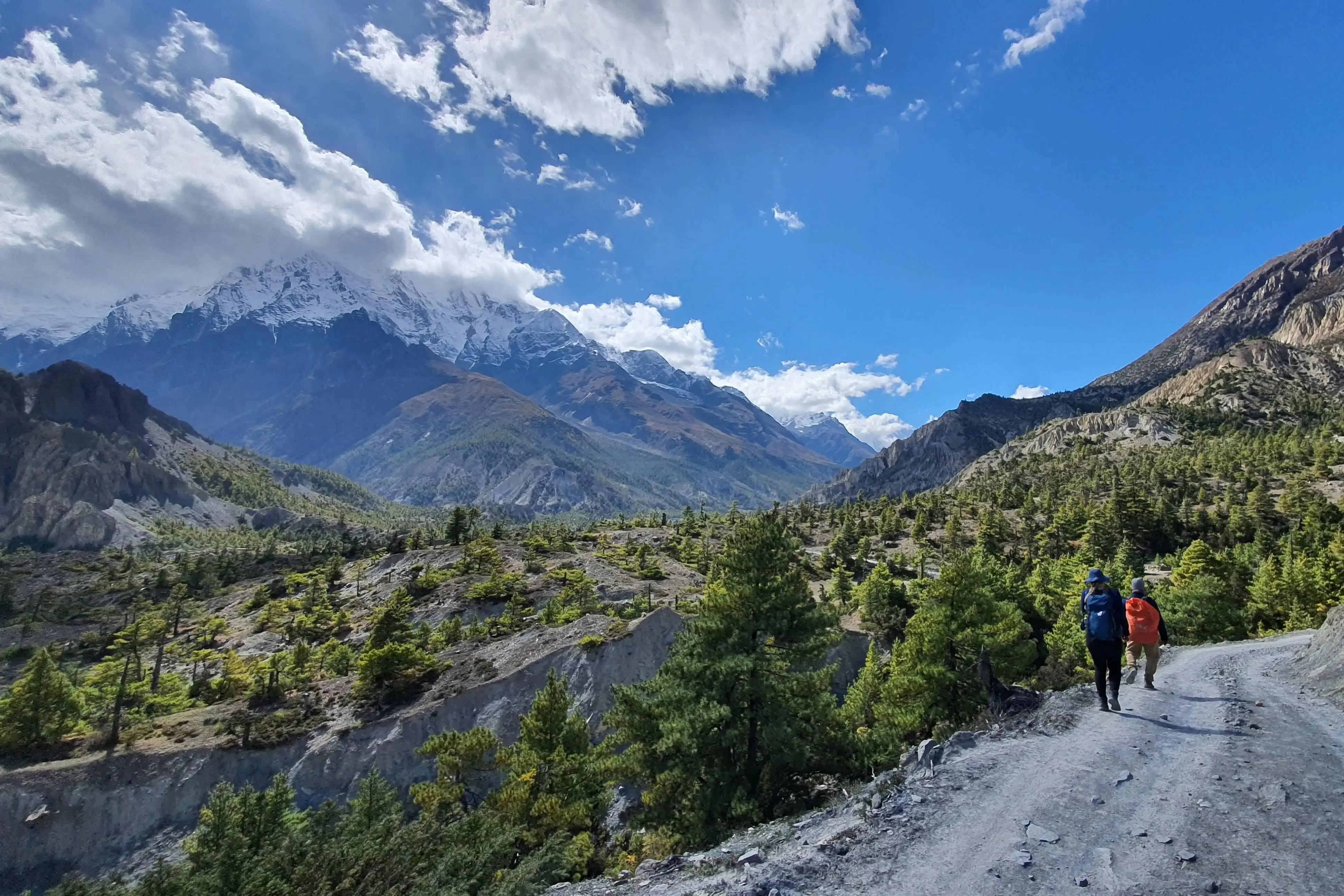
The Annapurna Circuit Trek, one of Nepal's most popular Himalayan trek destinations, encompasses an extraordinary variety of landscapes from sub-tropical valleys to arid high-altitude deserts. The Circuit is approximately between 190 and 230 km, depending on the route taken, and takes 12 - 18 days to complete, combining physical effort with an experience of local culture.
Hiking through the valleys of the Marsyangdi and Kali Gandaki rivers, trekkers along the Annapurna Circuit are rewarded with stunning views of some of the tallest mountains in the world, including Annapurna I (8,091 m), Dhaulagiri (8,167 m) and Manaslu (8,163 m). Treks traditionally begin in Besisahar or Jagat and finish in either Jomsom or Nayapul, with the Thorong La Pass (5,416 m) deemed to be the highest point along the trail.
Most of today's trekking itineraries contain a shorter distance travelled by jeep between Besisahar and Chame eliminating 80 to 120 km of hiking while still providing the trekker with an authentic experience. All itineraries include between 10 - 16 trekking days plus travel from Kathmandu, and trekking time will vary based on the number of acclimatization days undertaken to avoid the effects of altitude sickness.
Expect to hike between 10 - 22 km per day for approximately 5 - 9 hours. Daily elevation gain on the hike will vary widely from approximately 1,000 m for the more difficult days. The individual variation along the route provides additional options of potential customisation in terms of physical exertion. Some may choose to do the entire circuit at an arduous pace while others may take a more leisurely approach to doing the circuit over 14 days.
A standard 14-day trek itinerary provides a clear breakdown of distances, durations, and elevations, helping trekkers gauge daily efforts. This version assumes driving from Kathmandu to Jagat (213 km, 8-9 hours) and flying or jeeping out from Jomsom.
| Day | Route | Distance (km/miles) | Duration (hours) | Elevation Gain (m/ft) |
| 1 | Kathmandu to Jagat (Drive) | 213 / 132 | 8-9 | 1,100 / 3,610 |
| 2 | Jagat to Dharapani | 15 / 9.3 | 5-6 | 1,400 / 4,500 |
| 3 | Dharapani to Chame | 15 / 9.3 | 5-6 | 2,630 / 8,625 |
| 4 | Chame to Pisang | 15 / 9.3 | 5-6 | 3,300 / 10,825 |
| 5 | Pisang to Manang | 16 / 9.9 | 6-7 | 3,370 / 11,710 |
| 6 | Acclimatization in Manang | 0 / 0 | 4-5 | 3,540 / 11,614 |
| 7 | Manang to Yak Kharka | 11 / 6.8 | 4-5 | 4,110 / 13,480 |
| 8 | Yak Kharka to Thorong Phedi | 8 / 4.9 | 3-4 | 4,450 / 14,465 |
| 9 | Thorong Phedi to Muktinath (via Thorong La) | 16.5 / 10.3 | 8-9 | 3,800 / 12,456 |
| 10 | Muktinath to Marpha | 22 / 13.7 | 7-8 | 2,670 / 8,760 |
| 11 | Marpha to Ghasa | 23 / 14.3 | 7-8 | 2,010 / 6,590 |
| 12 | Ghasa to Tatopani | 14.5 / 9 | 5-6 | 1,190 / 3,900 |
| 13 | Tatopani to Ghorepani | 17 / 10.6 | 7-8 | 2,810 / 9,215 |
| 14 | Ghorepani to Nayapul/Ulleri, then Pokhara | 22 / 13.7 | 5-6 | 2,100 / 6,890 |
This table reflects a typical 14-day trek (~170 km total), including the most difficult descent days after crossing Thorong La Pass (5,416 m). Alternate versions of the circuit, such as adding Tilicho Lake, would add approximately 40-50 km and add 2-3 days to the trek.
The total circumnavigation around Annapurna (classic circuit) ranges between 190-208 km (118-129 miles) depending on the route taken and other variables such as how many parks are open and where people start; thus, it would take 16-21 days to complete a full circuit starting from Besisahar without taking shortcuts; however, due to a large amount of road construction from the 2010s onward, one could reach as far up the circuit in a four-wheel drive to either Ngawal or Manang and reduce the distance of the foot portion of the circuit by approximately half (going from 96-117 km).
Consequently, these new trekking routes offer many trekking options from the classic circuit, including opting for shorter treks with round-trips (Mt. Poon Hill with ACAT) covering 83-150 km in 6-12 days, which work well for those that want a shorter trek due to time constraints. If one wants to take side trips to Tilicho Lake (4,919 m) or Kang La Pass, those distances would add 20-40 km and would take 15-18 days due to the need for adequate time to acclimatize properly.
The duration of each trek will depend on pace (of those completing the trek), weather, and physical fitness of the individual or group completing the trek - fit adult groups can complete within 10 days; however, families typically take 18-20 days. Permits (TIMs and ACAP) require completion of the minimum number of days in order for people to begin pacing themselves as early as possible.
The first few days travel the Marsyangdi Valley with rolling terrain (10–16 km per day @ 400 m–900 m.Up gain) through Gurung and Tamang settlements surrounded by planted terraced crops, some lowland rice fields, and some rhododendron forest. Trails are generally flat dirt trails, with only slight elevation changes (however, there are a few places with rocky trails) that cross major rivers with large footbridges.
The next portion of the trek to Manang includes many more elevation changes due to the much steeper terrain (i.e., straight-up granite mountain faces with a few very small switchbacks over a 8 km to 16 km). The acclimatization hiking will take into account the fact that there is an elevation gain of 1,200 m (which is a total of about 16.5 km of elevation) to cross over the Thorong La pass (average hiking time is approximately 8 hours to 9 hours to complete the Thorong La pass).
The descents from Thorong La to the Mustang Valley (total distance ~20 km to 23 km/day) will take you through the deepest gorge on the planet - the Kali Gandaki gorge, where you will continue approximately 100 km straight down to Tatopani (1,000 m), encountering strong winds and dry land along the way. For those that would like to complete the extended portion of the trek, you will see the sunrise on Poon Hill in the morning.
There is a large range of trek times depending on the trip date. Acclimatization days typically take 4 to 5 hours, and there are some days that take 9 hours to complete the Thorong La pass crossing. The terrain varies between flat valley walking, huge rocky switchbacks, and boulder scrambles; therefore, poles are essential for all descents.
Elevation begins at 800m (Jagat), ascends progressively to 3500 m (Manang) peaks at 5416 m (Thorong La) then descends to 1000m (Tatopani). Net vertical gain is 200 - 500m/day average, plus 2 days of rest can reduce acute mountain sickness (AMS) symptoms.
Climb gradually. Day 5 will be Pisang (3300m), Day 7 Yak Kharka (4110m). Headaches begin when you reach 4000m, but staying hydrated, using diamox and having experienced guides can help. Starting at 3am for the crossing of the pass through the winds is important.
This profile graph demonstrates the continual ascent, rests that are needed along the way and quickly coming down again. This shows the importance of a rushed itinerary whereby being evacuated could happen.
Packing for long distances requires lightweight packing (10 to 15 kg) over a period of 12 to 18 days. Waterproof trekking boots, layered base thermal clothing (seriously cold at Thorong Phedi down to negative 15°C), sleeping bag with a temperature rating of 0°C, and trekking poles are very important. Carrying water purification tablets or UV light systems is necessary to maintain daily water consumption of 3 litres to 4 litres.
Teahouses provide you with dal bhat (rice and lentil) which averages around USD 5.00 to 10.00 per meal. You should also carry snacks, like nuts and chocolate to have during long days on the trek. You can use solar chargers to charge devices that require electricity and you must carry and use a headlamp to depart early to cross the pass.
Some of the main attractions of the Annapurna region are the ancient gompas of Manang, Muktinath’s sacred temple for Hindu-Buddhist pilgrims, and the apple orchards of Marpha. Wildlife species include Blue Sheep, Himalayan tahr, and Snow Leopards (the last being extremely rare to spot). Some of the region’s natural attractions include Tatopani’s natural hot springs for a soak after trekking and the fantastic view from Ghorepani’s Poon Hill (3210m) at sunrise of Dhaulagiri (8167m). The ecosystems you will experience vary from rice paddies to alpine tundra.
Plan to spend about $1,200-1,800 per person to trek in the Annapurnas for two weeks (the cost for guides and/or porters is about $25-$30 per day and food is $25-$40 per night). You will also need permits (ACAP $30; TIMS $20). It is possible to fly from Jomsom to Pokhara and save 3-4 days for $100.
Using licensed guides allows you to find your way, receive insight into the weather conditions in the region, and use porters who carry half the amount of your pack. Group trekking allows each member to pay less; whereas, trekking alone incurs a higher cost for a private trek.
Roughly 30%-50% of trekkers develop Acute Mountain Sickness (AMS) above 4000m; descend immediately if you experience headache and/or vomiting. Guides will have supplemental oxygen and can provide helicopter evacuations (approximately $500/km) when road access assists with a rescue after Chame.
There are leeches in the lowlands during the rainy season; and rocks will fall during the rainy season. It is mandatory to have travel insurance covering a minimum of $100,000 for a helicopter evacuation.
The Annapurna Circuit covers approximately 170-230 km over 12-18 days and will provide some of the most impressive views in the Himalayas; however, be prepared to trek a great deal of distance and altitude. If you would like a seamless, expertly led trek, please contact Miracle Treks to book your 2026 trek with your custom itinerary, permits and porters to ensure you reach the summit of Thorong La.
