
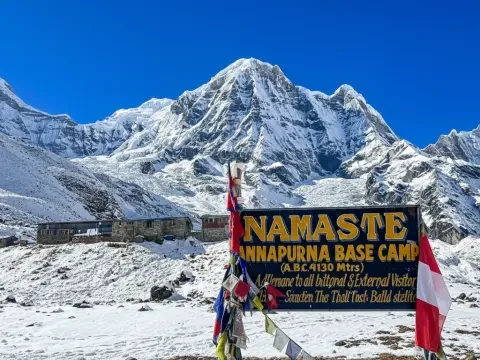
With its vivid colors and warm weather, spring is a wonderful time to trek to Annapurna Base Camp (ABC) in the Annapurna region of the Himalayas. You can enjoy this classic trek for 7-12 days while sightseeing the blooming rhododendrons, magnificent views of several mountain ranges, and not too many other trekkers on the trails.
Spring is one of the best times of the year (the second-best after autumn) to trek from Pokhara to ABC (March to May). The forests are filled with blooming rhododendrons, butterflies, and birds in a sea of pink against the snowy peaks of Annapurna I (8,091m) and Machhapuchhre (6,993m).
In march through may the average temperatures during the day will be between 5-18 degrees in the lower parts of the trek and should drop to about -5 or lower at night when you are near ABC (altitude of 4,130m). You will also have clear days to view the amazing sunrises from both Poon Hill and ABC, which will not be the case if you were trekking during the monsoon months when the haze will cover the mountains.
There will be much fewer trekkers compared to the peak autumn season resulting in quiet teahouses but enough trekkers to provide safety and companionship. It is the ideal time for nature lovers who would enjoy watching beautiful flowers bloom without the cold of winter.
Mainly you will take the classic 115km trek from Pokhara to ABC over 7-12 days and most trekkers follow the Poon Hill route to acclimatize to the altitude and take in the views.
Permit Fees: TIMS: (USD 20), ACAP (USD 30) can be purchased in Pokhara. If you choose to walk for 5-7 days on the shorter alternative route, you will be at a greater risk of being affected by the altitude.
| Route Segment | Distance (km) | Elevation Gain (m) | Spring Highlights |
| Nayapul to Ghorepani | 15 | 1,800 | Terraces, early blooms |
| Ghorepani to Chhomrong | 14 | -200 net | Poon Hill sunrise, rhododendrons |
| Chhomrong to ABC | 20 | 1,800 | Sanctuary amphitheater views |
| ABC to Jhinu/Nayapul | 25 | -2,500 | Hot springs relaxation |
Each month has its own weather with March being cool and dry, April being mild and sunny and May being hot.
March can be dry with little rain but average temperature highs around 4 to 10 degrees Celsius. Night-time temperatures can reach as low as -8 to –2 degrees Celsius. Snow may be present around ABC at this time creating beautiful wildlife trails but also creates slick sections of trail by late March. There are usually plenty of sunny days; therefore, I will be wearing heavy jackets.
April is typically the nicest month in terms of temperature with average daytime temperatures ranging from 8 to 15 degrees Celsius and average night-time temperatures from -4 to 2 degrees Celsius. There will be limited precipitation; this is when the rhododendron flowers are at their peak, usually mid-April. All trails should be fairly dry and wildflowers will be abundant.
May is expected to be the warmest month of the spring season, with an average daytime temperature of 12 to 18 degrees Celsius and -3 to 6 degrees Celsius at night. While there will be a chance of moderate rainfall late in the month (pre-monsoon season), May mornings are often clear. Light-weight camping gear may be needed for this month.
| Month | Day Temp (°C) | Night Temp (°C) | Rain Risk | Visibility |
| March | 4-10 | -8 to -2 | Low | Excellent |
| April | 8-15 | -4 to 2 | Low | Superb |
| May | 12-18 | 3-6 | Moderate | Clear AM |
You can also rent equipment in Pokhara as it is affordable.
- Acclimatization: Days of rest at Ghorepani/Chhomrong, as AMS onsets above 2,500m; drink 4 litres of a day; maximum ascent of 300m/day.
- Fitness Preparation: Moderate fitness; training on staircases/hills (2 months before trek) simulating daily 6-8 hour walks with 1,000m gain.
- Navigation/guides: Well-marked trails; safety, culture and logistics can be better with a guide/porter (USD 20-30/day).
- Wildlife & Culture: Some may spot Himalayan Tahr & Danphe Birds, and it is important to respect the customs of the Gurung & Magar people i.e., using the right hand when you eat and to dress modestly when entering villages.
Costs: Budgets for USD 400 to USD 800 each (including: guides, food, and permits); average teahouses costs are NPR 500 to NPR 800 per night.
Visit Gurung Museums in Ghandruk, learn about the traditional dances of the Mardi pdances, and celebrate the local culture through festivities like the springtime New Year (Losar).
Enjoy a teahouse stay and sample local dishes like momos and thukpa while supporting the local economy in an ethical way.
The Annapurna Base Camp Trek during the spring offers beautiful sights of blooming flowers, breathtaking views, and plenty of chances for adventure to create unforgettable memories. Are you ready to put on your hiking boots? Contact Miracle Treks now to find out about customized packages, quality guides, and hassle-free reservation processes so you can begin your Himalayan journey today!
